Since the end of regulated gas prices on June 30, 2023, the reference price published each month by the Energy Regulatory Commission (CRE) is no longer imposed on suppliers. Reducing your heating bill therefore involves both controlling consumption and paying closer attention to the energy contract signed.
Gas Contract and Reference Price: A Often Overlooked Item
Most guides on heating savings focus on daily actions. They overlook a crucial lever: the choice of energy contract. Since the CRE has been publishing a monthly reference price, suppliers’ offers can significantly deviate from this benchmark, both upwards and downwards.
Comparing offers at least once a year allows you to check if the price per kilowatt-hour charged remains consistent with the reference price. A difference of a few cents per kWh, multiplied by the annual consumption of a gas-heated home, can represent several dozen euros in difference. The resources available on chauffage-economique.com detail the criteria to examine when deciding between fixed offers and indexed offers.
For households heated with electricity, the logic is similar. The price of energy has risen significantly faster than general inflation in recent years. Checking the relevance of your subscription (contracted power, off-peak option) remains an underused reflex.

Targeted Insulation and Reducing Heated Volume: Profitable Trade-offs
Before investing in new equipment, the priority question concerns the housing envelope. Heat losses through windows, doors, and attics are the primary factor in overconsumption.
Low-Cost Micro-Work
Some actions require only a minimal investment and produce measurable effects from the first winter:
- Applying adhesive seals on windows and installing insulating door bottoms reduces cold air infiltration, which is responsible for a significant portion of heat loss according to Ademe.
- Installing thick curtains in front of windows, especially those facing north, limits cold night radiation.
- Closing shutters at dusk creates an insulating air layer between the glazing and the outside.
Reducing the volume to be heated is a lever often underestimated. Closing the doors of unoccupied rooms and lowering their radiators to a minimum maintenance level (around 16 °C) avoids wasting energy on empty spaces.
Attic Insulation: An Investment That Stands Out
Uninsulated attics account for a significant portion of heat loss. Their insulation, through blown-in flakes or rolled insulation, remains one of the home improvements with the shortest return on investment. Field returns vary on the exact payback period depending on the type of housing.
Programmable Thermostat and Room-by-Room Regulation
Heating to the right temperature at the right time is the simplest principle to apply, yet one of the least respected. Ademe recommends 19 °C in occupied living spaces and 16 to 17 °C in unoccupied rooms or at night.
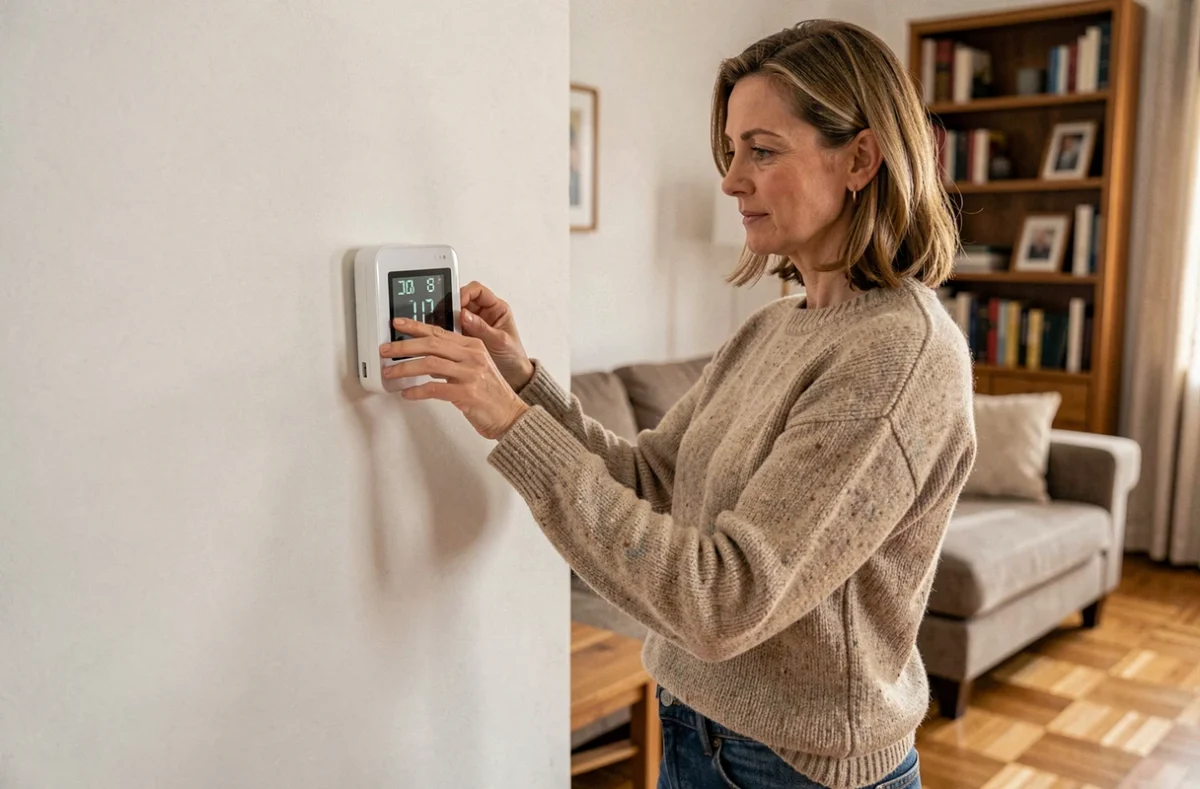
A programmable thermostat, wired or connected, allows for the automation of these settings. Connected models sometimes detect when a window is opened or when occupants are absent to automatically turn off the heating.
Room-by-room regulation, via thermostatic valves on water radiators or individual timers on electric radiators, further refines control. A bedroom does not need the same temperature as a living room, and an unoccupied office during the day does not need to be maintained at 19 °C.

Financial Aid in 2026: MaPrimeRénov’ and CEE, Two Programs to Combine
The landscape of energy renovation aids has significantly evolved. Decree No. 2026-822 of August 25, 2026, has refocused MaPrimeRénov’ towards decarbonized heating equipment (heat pumps, biomass boilers, district heating).
At the same time, energy savings certificates (CEE) remain a distinct and often underutilized lever. The sixth period of the CEE runs until December 31, 2030. These bonuses, funded by energy suppliers subject to a legal obligation for savings, do not constitute a direct budgetary subsidy from the State.
- MaPrimeRénov’ and CEE are cumulative on the same project for boiler replacement or insulation.
- A boiler already subsidized may, in some cases, entitle you to a new bonus upon its replacement, according to the decree of September 4, 2026, reported by Kelvin.
- The amount of CEE varies greatly depending on the supplier and the operation. Comparing several CEE bonus offers before signing a quote can represent a difference of several hundred euros.
The available data do not allow for conclusions about the exact evolution of the scales beyond 2026, but the trend towards refocusing on decarbonized solutions seems confirmed by the texts published this fall.
Maintenance of Heating Equipment: A Performance That Degrades Silently
A dirty radiator or an unmaintained boiler consumes more to produce the same level of heat. Bleeding water radiators at the beginning of each heating season eliminates air pockets that block the circulation of the heat transfer fluid. The operation takes a few minutes per device and requires no specialized tools.
For gas boilers, annual maintenance by a professional is a legal obligation. Beyond compliance, this maintenance allows for checking combustion efficiency and detecting any potential loss of efficiency. A poorly adjusted burner can significantly increase consumption without the occupant noticing a decrease in comfort.
The heating bill depends on interacting factors: the quality of the housing envelope, temperature regulation, type of energy contract, and condition of the equipment. Acting on just one of these levers produces limited gains. It is their combination, adapted to each home, that generates a sustainable and noticeable reduction in the annual amount.